








DecImmune's therapeutic program capitalizes on the pioneering discoveries by Drs. Michael Carroll and Francis Moore at Harvard Medical School of the tissue-damaging immune and inflammatory cascade following vascular injury produced by interrupted blood flow. This injury occurs in a broad range of conditions where blood flow has been temporarily occluded or impeded and results in acute inflammation, irreversible tissue damage, scar formation, and loss of tissue functionality. As described below, recent data expands our knowledge of the non-ischemic triggers that can lead to vascular inflammatory conditions, opening up a range of therapeutic opportunities.
DecImmune has identified an invariant fragment of non-muscle myosin heavy chain II (NMHC-II) and a conserved endogenous IgM that recognizes this motif, which we call the N2 sequence. Expression of the N2 target antigen can occur, in one example, in an ischemic blood vessel during the re-establishment of blood flow. This IgM binding to damaged cells activates the N2 cascade, resulting in enhanced tissue destruction. More than 25 peer-reviewed publications, including studies in models of cardiovascular injury, shock, wound/trauma, second degree burns, and mesenteric ischemia have validated the N2 pathway as a major pathway leading to localized immune activation and resulting tissue damage (see diagram).
N2 Pathway: Critical to Autoimmunity
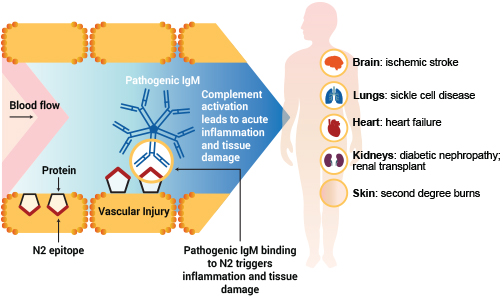
The N2 pathway is central to innate autoimmune inflammatory processes. Multiple stressors can induce expression of the N2 epitope of non-muscle myosin heavy chain within large and small vessels. Once the target N2 epitope gains access to circulating pathogenic IgM and activation of a downstream cascade of inflammation and tissue damage ensues.
Our latest research demonstrates that an otherwise non-pathogenic IgM antibody becomes pathogenic in the setting of injury from a range of insults which have in common oxidative stressors. DecImmune is developing a humanized antibody, DeciMab™, which inhibits pathogenic IgM binding and the subsequent inflammatory cascade.
N2-Driven Inflammatory Cascade Inhibited by DeciMab
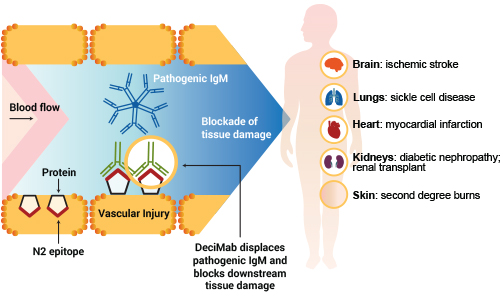
We have developed a humanized antibody, DeciMab, that blocks the N2 cascade. In acute settings the N2 epitope can be masked by a single IV dose of our DeciMab, preventing IgM access, blocking this cascade and preserving tissue function. The N2 sequence and IgM are fully conserved from mice to humans.